Residential solar is changing.
For years, the value proposition was relatively straightforward: install solar, generate electricity during the day, export excess energy to the grid, and use those credits to offset the power you consume later.
Today, that equation is becoming much more complex.
Utility rate structures are evolving. The value of exported solar varies significantly by market. Time-of-use pricing is becoming increasingly important. Grid demand continues to rise, while homeowners are paying closer attention not only to energy savings, but also to backup power, resilience, and greater control over how they use electricity.
Against this changing market backdrop, Renon Power launched Renon Battery Banter, a podcast series created to bring together industry partners and professionals to discuss the trends, challenges, and technologies shaping the future of solar and energy storage.
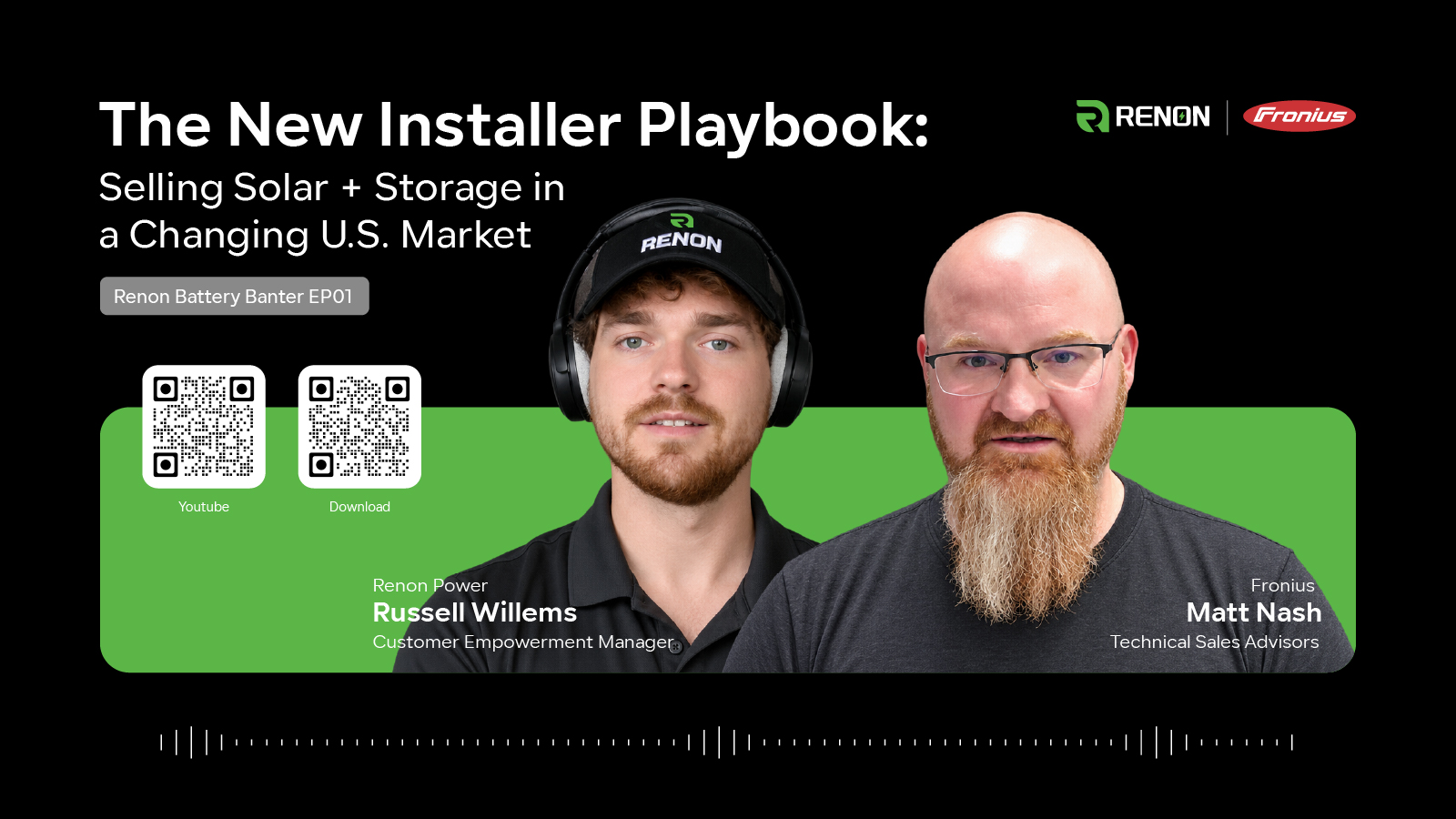
In the first episode, “The New Installer Playbook: Selling Solar + Storage in a Changing U.S. Market,” Russell Willems, Customer Empowerment Manager at Renon Power, sits down with Matt Nash, Technical Sales Advisor at Fronius USA, to discuss what these changes mean for residential solar and storage—and, more importantly, how installers can prepare for what comes next.
Renon Power develops advanced battery energy storage systems for residential, commercial & industrial, and utility-scale applications, with a focus on safety, scalability, and seamless inverter integration.
Fronius brings decades of expertise in solar power and intelligent energy management, with solutions focused on efficient solar generation, storage integration, and energy optimization.
Together, the two companies are expanding options for residential solar + storage installers. The Fronius GEN24 Plus and Renon Xtreme HV 1.0 have been listed by the California Energy Commission (CEC) as a paired residential storage solution—supporting a more streamlined path for system specification, permitting, and interconnection in California.
The residential solar market is moving beyond the traditional solar-only model. In Episode 01, Russell and Matt highlight three shifts that are changing how homeowners—and the industry—think about solar + storage.
In many markets, exporting excess solar to the grid no longer delivers the same value it once did. As net metering and export compensation evolve, self-consumption is becoming increasingly important to the economics of residential solar.
Time-of-use rates and higher peak-period electricity costs are changing when energy has the most value. At the same time, growing electricity demand is adding pressure to the grid and reshaping utility pricing.
Storage Moves Center Stage
Battery storage is increasingly valued for more than backup. It can help homeowners retain more of their solar energy, improve energy independence, respond to changing electricity prices, and potentially participate in emerging programs such as Virtual Power Plants.
Start with the Energy Profile: Understand the customer’s consumption before designing the system.
Design Around the Utility Rate: The right system design depends on when energy costs the most—not just how much energy the customer uses.
Sell the Use Case, Not Just the Battery: Lead with the homeowner’s goal, then build the system around it.
Check Programs Before the Proposal: Know the local programs before you price and propose the project.
Installer-friendly connections and simplified commissioning on the Fronius GEN24 Plus, combined with the stackable design of Renon Xtreme HV 1.0, help make system installation faster and more straightforward.
The high-voltage architecture enables smaller battery cabling and reduces unnecessary power conversion, supporting easier installation and more efficient energy transfer.
Fronius Solar.web provides visibility into solar generation, household consumption, battery charging, and grid interaction, while Energy Cost Assistant can schedule battery discharge around higher-cost electricity periods.
With battery storage and backup functionality, homeowners can maintain greater energy independence during outages, while the flexible system architecture supports both current needs and future storage expansion.
Watch the full episode to explore the conversation in depth, or download the Residential Solar + Storage Readiness Guide to help prepare your next project with greater confidence.